Ten ways I would improve Facebook
I am normally the first to defend Facebook’s various redesigns, although only because most of the vitriol directed at them is from people who know where everything used to be but not how to look for them. But this one… this one is a bit of a disaster, isn’t it?
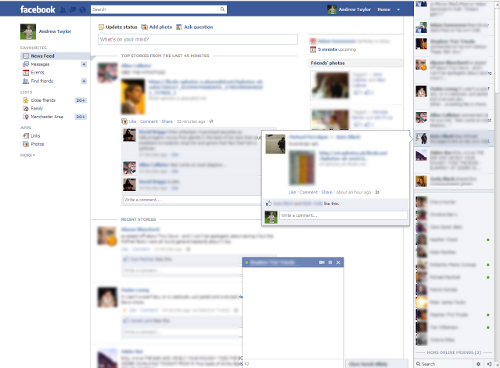
It’s just… everything. Everywhere. All at once. I mean, obviously I put the blur on myself, but still… Google’s been systematically taking out UI elements and spacing things out, and as a result all their websites look gorgeous. The new-look Gmail has been out for about a day and already people can’t believe how cramped the “compact” option is – even though that was the only size available on Tuesday morning. I have genuinely stopped visiting Facebook unless it emails me.
So here’s what I’d do. I’ve tried to keep all this within Facebook’s general ethos: profitable, brand-friendly, oriented towards real-life connections, wants to be your home page, and big on news feeds. I really like the idea of Facebook and I wouldn’t want to turn it into Twitter or Google+. I just don’t like the direction it’s going or the handcart it is riding there.
1. Scrap the stupid fucking chat/news sidebar thing
Nobody likes it, four columns is too many, and it does nothing the main site can’t do. The one potentially useful part of it – the old-style chat panel – is by default scrolled off the screen with an invisible scrollbar, while the scrollbar next to the sidebar scrolls the page on the other side of it. Use the space freed up by eliminating the sidebar to increase the font size to something halfway readable.
2. Get rid of all the irrelevant crap
The right navigation bar should only have information relevant to the page you’re looking at. No status updates from a year ago, bad suggestions for people it thinks I might know, random photos, or anything like that. If you’re on the main landing page then it should have notifications, event invitations and so forth. And if you click “10 invitations”, it should take you to the events page rather than creating a pop-out with another link in it. If you really must put an advert in there then go ahead, but stop accepting adverts from obvious scams, because it’s unethical and makes you look dodgy. If the adverts could not take the form of polls, that’d be nice too.
Get rid of all the bullshit in the news feed, too. I don’t care if my friends change their pictures. I don’t care if Sarah is now friends with some guy I’ve never heard of. I don’t care if someone’s got a high score in a game. I don’t care if a friend “likes” a status posted by someone I don’t know. Basically, if my friends didn’t explicitly tell me about something, please assume I won’t care about it and don’t show it to me. Oh, and ditch “questions”. The overlap between “people who post questions” and “people whose friends like to see questions” must be essentially nil.
Basically, show me things I want to see, not things you want me to see. I won’t click on the latter anyway, and it will only deter me from visiting the site at all.
3. Never guess what might be important to me
Suggested friends should have at least 10 connections to me rather than having a passing acquaintance with one of the 200 people I’ve vaguely met since I joined the site. Similarly, “top stories” are a bit of a disaster area. The other day, some guy I barely know commented on a photo I’d never seen, in Russian, and Facebook considered this a “top story”. I moaned about that on Facebook and the first comment was (essentially) “Dammit, Facebook considers this status a top story”. Hopefully, “top stories” won’t be needed once the newsfeed is free of all the crap I just mentioned. I wouldn’t mind this too much if Facebook hadn’t insisted I tell it who my “close friends” are – so now their updates come through as notifications and the news feed has its own, independent and much less accurate stab at what it reckons I might care about.
Similarly with the left navigation bar: it has basically random shit in it. It should have the main navigation links – newsfeed, events, messages and so on – and then a list of your favourite pages – like the “quick links” lab experiment in GMail, this would let you bookmark any page within Facebook, be it a fan-page, profile, group, event, status, photo, album, message thread, whatever – and then a list of non-favourited online people so you could chat to them. The little icons for each section/group would remain, except that profiles’ icons would be a green or blue circle depending on whether the person was online. The gist here is that I decide what I want to see, rather than Facebook’s servers guessing. Even a casual glance at the chat sidebar shows they’re shit at that.
On the subject of the left navigation bar, the ‘friends on chat’ thing needs to have names, and online indicator spots big enough that I can discern their colour. I really thought this stuff was obvious.
4. Scrap "smart lists" and implement "circles" in a sane way that makes sense for Facebook
“Smart Lists” are rubbish. Nobody’s interested. Google+ beat you hands down and you slavishly copied it, except hopelessly missing the point. Thanks to circles, people use the same Google+ account for professional and personal networking – and with Facebook’s market dominance, getting circles right could help it be LinkedIn and FetLife at the same time, to the same people. (Another thing Facebook does hopelessly at the moment is adult content. It’s insistence everything should default to public means it has to have a blanket ban on nudity, and that really restricts how it can be used.)
I think a better way to integrate circle-like functionality into Facebook would be to add what I call “contexts”. Each of your friends, groups, pages and subscriptions exists in one or more contexts – Manchester, skepticism, television, university, whatever – so let us build them. The ‘context’ page would then show all the posts from those groups, people, pages and so on. The “friends” context, and perhaps the “family” one, would be special – these would have to be mutual and would act as the friend list does now – these are the people you can invite to events and message freely and so on.
I get that nobody wants to sort through 200 ‘friends’ and put them in lists, but still, “Smart Lists” isn’t the answer. There’s no point trawling my friend list looking for anyone who’s listed “Manchester University” under “education” because that’s almost certainly not how I know them and it’ll miss loads of people who haven’t bothered filling that out. On the other hand, pretty well everyone at Skeptics has joined the Facebook group for it, so I could click “make context from this group”, it would create a new context named after the group and add the members and the group itself, and I’d be 90% of the way there. Add a couple of feeds and a page or two, and I’m sorted. I could probably import a couple of other skeptic groups and have a really useful resource.
Then I can add interests and other profile information to contexts, so my skeptic friends can see I’m on the acupuncture discussion boards without my family thinking I endorse it, and a Mistress could be open with all her subs about what fetishes she’s into without her boss being able to see it too. Friends and colleagues would see different email addresses. I would imagine maybe that members of a context could see that you were connected with other members of the same context, as distinct from Google+’ system where you can simply see a list of people in my circles without knowing which ones they’re in – so your professional and personal circles wouldn’t see each other.
5. Allow me to pull in information from outside Facebook
Facebook is keen to be my homepage, and it’s equally keen to know what I like, so it’s absurd that they force content creators to support them before I can read it there. Google Reader doesn’t work that way and nor should this. It will only encourage people to create fan pages if they discover they already have an army of Facebook subscribers.
Twitter has a good API, too. Let me add Twitter users to my contexts too. And perhaps tweet comments as replies if I’ve linked my Twitter account. Heck, maybe even invent a Twitter account for me if I haven’t. Turn Facebook into a viable Twitter client. Don’t compete with Twitter – eat it.
While we’re here, though, scrap the dumb “fan pages” generated automatically from Wikipedia, because they’re just hopeless.
6. Let me put non-Facebook content on my profile
Once the above is done, I should be able to add RSS and Twitter feeds to my profile so people can choose whether to subscribe in Facebook or not – and if I notice lots of people read my RSS or Twitter through Facebook, I should be able to link them so I can interact with them directly. Right now, I have to choose to show all my tweets to everyone or none to anyone, and I’ve no idea what my friends would prefer. Facebook are sort of fixing it, since I can now just about hide certain kinds of updates from certain people only, but really, who’s going to use that in any but the most annoying cases? And why should I have to have to import my blogposts as “notes”? (Answer to rhetorical question: so my friends don’t suspect the content is available elsewhere.)
I should be able to use Facebook as a landing page in the mould of Minicard. They want to be my permanent email address, why not my permanent homepage too? If it’s easy to set up then people will go for it, much like all bands have a mySpace just because it’s easy to set up and you can put songs on there. And then your users are pretty well locked in.
7. Fix the email alerts
I’ve mentioned this before, and they’d nearly got this right – implementing nearly all my ideas – and then they decided everyone was getting too many emails so they unilaterally changed all my settings and now I only get an email if I get a message and don’t visit the site for a bit. By the time it deigns to email me about it, there might be several replies. Not good enough, especially when they’re trying to set themselves up as a viable primary email address. A secondary messaging service that doesn’t proactively alert me when I have new mail is worse than useless – it’s like prayer or homœopathy: it gives people the illusion of having contacted me so they won’t bother actually doing so.
Secondly, the “other messages” folder is a liability. Events send me important updates and I never see them because they’re ferreted away without even a badge update on the home screen, much less an email. I have to explicitly check for these ‘bacn’ messages. It’s absurd – why would I not want updates about events I’m attending?
8. Duplex API
Right now, it’s very easy for developers to piss information all up someone’s Facebook wall but almost impossible to take information from Facebook to use elsewhere. This is why Twitter apps are varied and fascinating while Facebook apps are X-to-Facebook syndicators, quizzes and vampyric ‘games’ designed to make you spam adverts to your mates. Facebook is built on newsfeeds, and every single one of them should be available as RSS. If my tweets go to Facebook but my Facebook updates don’t go to Twitter, then Twitter, not Facebook, will become my social hub.
9. Add a calendar
Facebook is a great events handler, and not bad for messaging if you use it as your primary provider, so why not add a calendar? Isn’t that just common sense? Isn’t that a great way to get me to visit every day? Isn’t it a great way to convince office networks to unblock you? I use Google Calendar for work and I’m sure people would use Facebook for it if it supported that and didn’t mean sharing all your drunken photos with everyone on your friends list. As an added bonus, it could show you your schedule around the time of events you’ve been invited to so you’d know if you were available.
It’d be nice to have the calendar available when you were planning an event too, and for preference some system to create a dateless event and let people tell you when they were and weren’t available.
If the calendar and messages could be available via Microsoft Exchange or similar so I could use the native apps on my phone, that would be even better, although I imagine Facebook would rather I use their app.
10. It should always be obvious what is going on
If adding someone to a list will email them, tell me before I do it. If you add “following” as well as “friending”, make it clear that that is what is happening. We don’t trust you, so be more open with us until we do, and then keep doing it – for a start you can make the Friend Finder use Gmail’s API rather than requiring my password like a scam website would. And if you’re advertising a dating app, don’t add “Brian Jones uses this!” underneath, because that will only discourage me from going anywhere near it – people generally aren’t keen to broadcast their resorting to internet dating to all their friends. Quite apart from anything else, stuff I don’t want my friends to know is usually stuff that will bore them and I feel sure we covered this in point 2.
In short, I think Facebook has the potential to be far more useful than it already is. It could easily be more widely applicable while at the same time appearing far more focussed than it is. It’s decreasingly obvious what Facebook is for, and that needs addressing, especially if they’re going to go for a TweetDeck-style intimidating-wall-of-text-based interface.
And maybe I’ve totally missed a key point, and all this wouldn’t work and Facebook’s way really is the best for all sorts of reasons I don’t understand – but if so then Facebook need to discuss it on their blog rather than filling it full of propaganda about people finding long-lost relatives or whatever on their website. But right now it seems like they’re adding features haphazardly and quietly deleting them again a year later if they’ve hopelessly failed. If they have a vision, they’ve not communicated it to me effectively.